Why Upstate Kids Are Referred to the Juvenile Justice System: What the 2024-25 Numbers Mean for Parents

What gets Upstate kids referred to South Carolina’s juvenile justice system? County rates, the most common reasons, and ages from DJJ’s 2024-25 data.
From July 2024 through June 2025, the South Carolina Department of Juvenile Justice (DJJ) received 12,667 referrals statewide. Of those, 3,474 came from the 10 Upstate counties: Abbeville, Anderson, Cherokee, Greenville, Greenwood, Laurens, Oconee, Pickens, Spartanburg, and Union. Behind every number in this post is a child, and a parent who never expected a call from the school or the police.
A referral means a child’s case was sent to DJJ for review. It is only an accusation, not a finding that the child did anything. The most common reasons kids were referred were hurting or trying to hurt someone, having marijuana, running away, having a handgun, and making threats. Here are the numbers every parent should know.
Key takeaways from the 2024-25 data:
- The Upstate accounted for 27% of South Carolina’s referrals.
- Kids ages 14 to 16 made up 63% of referrals, and 15 was the most common age.
- About one in five referrals was for hurting or trying to hurt someone.
- Boys made up 69% of referrals, and girls made up 31%.
- About 12% were for things that are only against the law because of a child’s age, like running away and skipping school.
Juvenile Referrals Across the Upstate, County by County
Greenville County had the most referrals in the Upstate because it has the most children, with 1,334 total. We compared counties of different sizes based on referrals per 1,000 children ages 10 to 17. Greenville County’s rate was 22.7, close to the statewide rate of 23.6.
| County | Referrals, FY2024-25 | Children ages 10 to 17 | Referrals per 1,000 |
|---|---|---|---|
| Greenville | 1,334 | 58,861 | 22.7 |
| Spartanburg | 462 | 39,303 | 11.8 |
| Anderson | 374 | 22,851 | 16.4 |
| Pickens | 302 | 11,735 | 25.7 |
| Oconee | 164 | 7,528 | 21.8 |
| Greenwood | 317 | 7,067 | 44.9 |
| Laurens | 184 | 6,945 | 26.5 |
| Cherokee | 62 | 6,008 | 10.3 |
| Union | 236 | 2,667 | 88.5 |
| Abbeville | 39 | 2,377 | 16.4 |
| Upstate total | 3,474 | 165,342 | 21.0 |
| South Carolina | 12,667 | 537,451 | 23.6 |
Rates varied widely across the Upstate. Spartanburg County’s rate was half the statewide rate. Meanwhile, Union County’s rate was the highest in the Upstate. Union also has the second-fewest children in the region, so a small number of referrals moves its rate a lot.
These numbers don’t explain why rates differ from county to county. A higher rate means more cases were sent to DJJ from that county. That can depend on how each county’s schools and police handle cases. A higher rate also doesn’t mean one county’s kids are different from another’s.
What Are the Most Common Reasons Kids Are Referred?
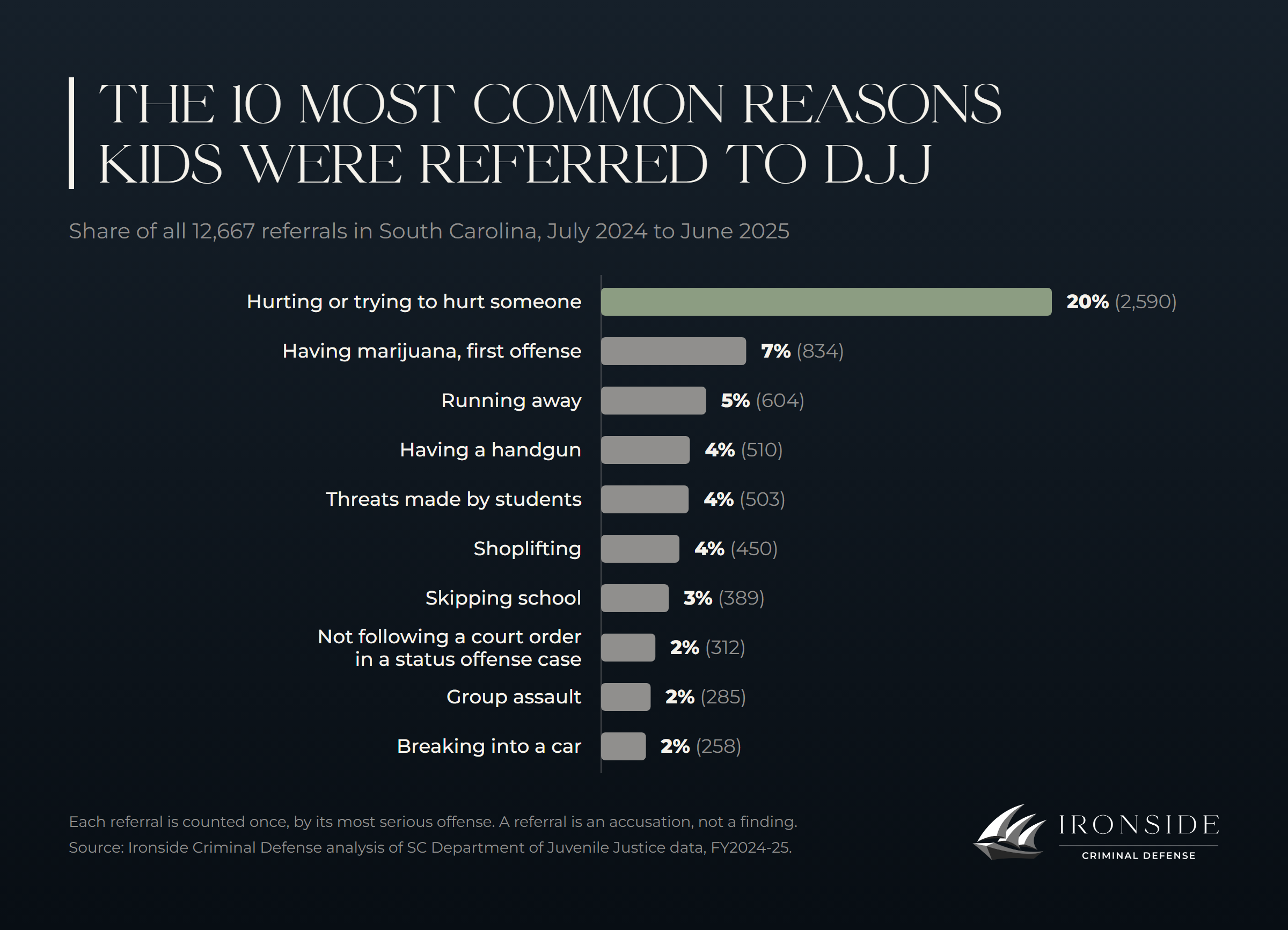
Across South Carolina, the top five reasons made up about 40% of referrals in 2024-25, and the top 10 made up about 53%:
- Hurting or trying to hurt someone (2,590 referrals, 20%): The official charge is third-degree assault and battery, the lowest level of assault and battery in South Carolina. It covers hurting someone, or trying, or threatening to hurt someone when the person is able to follow through. This can include a fight at school.
- Having marijuana as a first offense (834 referrals, 7%): Having any amount of marijuana up to 28 grams, or about one ounce. Having more than one ounce can lead to a more serious charge, because the law treats that amount as evidence of intent to distribute.
- Running away (604 referrals, 5%): Running away from home is a status offense, which means it’s only an offense because the person is under 18.
- Having a handgun (510 referrals, 4%): It’s against the law for anyone under 18 to have a handgun, with very limited exceptions, such as training supervised by a parent. This category also includes having a stolen handgun.
- Threats made by students (503 referrals, 4%): It’s against the law for a student to threaten to kill or hurt someone in any form, including a text, a social media post, or a direct message.
- Shoplifting (450 referrals, 4%): Taking items worth $2,000 or less from a store.
- Skipping school (389 referrals, 3%): Missing school without a valid excuse is also considered a status offense.
- Not following a court order in a status offense case (312 referrals, 2%): The official term is contempt of court, and it means the child is accused of not following the judge’s order.
- Group assault (285 referrals, 2%): The official charge is third-degree assault and battery by a mob. It applies when two or more people plan to hurt someone together and the person is injured.
- Breaking into a car (258 referrals, 2%): Breaking into, or trying to break into, a car to steal something.
Bringing a weapon to school accounted for another 227 referrals. South Carolina law covers guns, knives with a blade longer than two inches, and other weapons on elementary, middle, and high school property. It has limited exceptions, such as a weapon secured in a locked or attended car.
How Old Are Kids When They're Referred?
Most referrals involve kids in their mid-teens. Ages 14 to 16 made up 63% of referrals statewide, and 15 was the most common age. About 11% involved children 12 or younger.
Boys made up 69% of referrals, more than twice the share of girls at 31%.
Since July 1, 2019, South Carolina has treated 17-year-olds as juveniles. The only exception applies when a 17-year-old is charged with certain felonies: a Class A, B, C, or D felony, or a felony with a maximum sentence of 15 years or more. Even then, the prosecutor can still send the case to Family Court. Kids who were 17 made up 14% of referrals.
When Skipping School or Running Away Leads to a Referral
Some referrals are for things an adult could do without breaking the law. South Carolina calls these status offenses. They include running away, skipping school, and being beyond a parent’s control. Status offenses made up about 12% of referrals statewide in 2024-25.
Once your child turns 18, if their record is only for a status offense, they can petition Family Court to expunge it, which means clearing the official records. The judge must grant the petition if your child has finished any sentence, hasn’t had another case proven or been convicted since, and has no charges pending.
How Diversion Programs Help Kids Move Forward
A referral is the start of a review, not the end of your child’s story. DJJ looks at each referral, and the solicitor makes the final decision about whether the case goes forward.
For many kids, the next step is a diversion program instead of court. In 2024-25, juvenile arbitration programs diverted 3,602 young people statewide, according to DJJ. Juvenile arbitration is for first-time youth charged with nonviolent offenses. It’s voluntary, and it requires the child to admit the facts. A trained community volunteer works with the child on steps such as community service, classes, or an apology. A child who completes the program avoids formal prosecution in court.
Because arbitration requires your child to admit the facts, you should talk with an attorney before your child agrees to it.
Why These Numbers Matter to Upstate Parents
Many of the most common reasons on this list can grow out of everyday moments: an argument at school that turns physical, a message sent in anger, or a group of friends deciding to take something from a store. It’s easy to see only the name of the charge, not the Upstate kid behind it or what was happening in their life.
A referral can lead to meetings with DJJ, hearings in Family Court, and a juvenile record. Knowing what leads to referrals gives you a chance to talk with your child before one of those moments happens.
How to Talk With Your Child About These Numbers
- Talk about walking away: Hurting or trying to hurt someone was the most common reason for a referral. Help your child plan what to do when an argument starts to turn physical, such as walking away or finding a teacher.
- Explain that threats count in any form: The law covers threats made by text, post, or message. The FBI’s Columbia field office reported a 70% rise in hoax threats against South Carolina schools over the past year. The office has also said any threat posted online will be taken seriously.
- Be clear about handguns: Make sure your child knows it’s against the law for them to have a handgun outside of very limited situations, like training supervised by a parent.
- Talk about marijuana honestly: Having marijuana was the second most common reason. Any amount is against the law for your child to have.
- Help them step away from the group: Shoplifting, breaking into cars, and group assault were all in the top 10. Talk about how to say no and leave when friends start planning something.
- Keep the door open: If your child is skipping school or talks about leaving home, ask what’s behind it. Together, running away and skipping school made up about 8% of referrals.
About This Data
- Source: South Carolina Department of Juvenile Justice, FY 2024-25 Data Summary, covering July 1, 2024, through June 30, 2025, released under the South Carolina Freedom of Information Act.
- How referrals are counted: DJJ counts each referral once, by its most serious offense. A child can be referred more than once in a year. The category for threats made by students combines two DJJ codes for the same offense.
- Rates: Referrals per 1,000 children ages 10 to 17, using U.S. Census Bureau county population estimates for July 1, 2024. The referral counts include a small number of children under 10 and people 18 or older referred for conduct before they turned 18.
- Status offenses: Running away, truancy, being beyond a parent’s control, and contempt of court in a status case. Other published figures, such as 14%, also count underage alcohol possession and probation violations in status cases.
- Updates: We’ll update this post with 2025-26 data when it’s available.
Talk With an Attorney About Your Child’s Case
If your child has been referred, you should talk with an attorney before decisions are made about the case. Ironside Criminal Defense is led by Sloan Ellis and Brandi Hinton, two former state and federal prosecutors who both oversee every case. Our Greenville criminal defense attorneys explain each step to your family before it happens. Your first consultation is free, and it’s with an attorney.
Call 864-568-4750 or contact us through our online form today to talk with an attorney about your child’s case.
This post is for general information only and is not legal advice. Reading it does not create an attorney-client relationship. Every case is different; for advice about yours, talk with a criminal defense attorney.